
Introduction
Business Intelligence (BI) is evolving from a reporting function into a strategic decision-making capability. Businesses are no longer satisfied with dashboards that simply explain what happened. In 2026, organizations want analytics that can identify patterns, predict what may happen next, explain why it is happening, and help teams determine what action to take.
The rapid adoption of artificial intelligence, real-time data processing, semantic layers, and automated analytics is changing how organizations interact with business data. Gartner identifies AI agents, advancements in semantics, and the convergence of data and analytics platforms as major forces shaping the 2026 data and analytics landscape.
For organizations investing in digital transformation, understanding these business intelligence trends in 2026 is essential. The right BI strategy can turn fragmented data into actionable insights, improve operational efficiency, and support faster, more informed decisions.
What Is Business Intelligence?
Business Intelligence refers to the technologies, processes, and practices organizations use to collect, analyze, visualize, and interpret business data.
Traditional BI typically focuses on answering questions such as:
-
What happened?
-
How much did we sell?
-
Which products performed best?
-
Where did revenue increase or decline?
-
Which business processes are underperforming?
Modern BI goes further by combining analytics with AI, automation, predictive models, and real-time data to answer:
-
Why did it happen?
-
What is likely to happen next?
-
What should we do?
-
Can the system identify and respond to the issue automatically?
This transition is turning BI from a passive reporting system into a more proactive decision intelligence platform.
Top Business Intelligence Trends in 2026
1. AI-Powered Business Intelligence
Artificial intelligence is one of the most important forces shaping BI in 2026.
Modern BI platforms increasingly use AI to automate data preparation, identify patterns, generate insights, create queries, and help users interact with business data using natural language. TechTarget identifies AI-assisted analytics, natural-language querying, predictive analytics, and automated data preparation among the key BI developments shaping 2026.
Instead of manually building complex reports, a business user can ask:
“Why did sales decrease in the last quarter?”
An AI-enabled BI system can analyze relevant datasets, identify contributing factors, and present the findings in an understandable format.
How AI-powered BI helps businesses
-
Automates repetitive analytical tasks
-
Makes analytics accessible to non-technical users
-
Identifies patterns and anomalies
-
Supports predictive analysis
-
Generates natural-language explanations
-
Speeds up data-driven decision-making
The result is a shift from data exploration to intelligent data interaction.
2. Agentic BI and Autonomous Analytics
One of the emerging business intelligence trends for 2026 is the integration of agentic AI into analytics.
Traditional BI waits for users to open dashboards and ask questions. Agentic BI can monitor business data continuously, detect unusual patterns, investigate potential causes, and provide recommendations.
For example, an AI analytics agent could detect an unexpected increase in customer churn. It could then analyze customer segments, product usage, support interactions, and purchase history to identify potential reasons.
Instead of simply showing:
Customer churn increased by 12%.
An intelligent system could potentially provide:
Customer churn increased by 12%, primarily among customers in a specific segment. The increase correlates with lower product engagement and longer support response times.
Agentic analytics is still developing, but Gartner identifies AI agents and decision governance as major themes in the 2026 data and analytics landscape.
3. Conversational BI and Natural-Language Analytics
Business users increasingly want to interact with data without learning SQL or complex BI interfaces.
Conversational BI allows users to ask questions in natural language, such as:
-
“Show me this year’s revenue by region.”
-
“Which products have the highest profit margins?”
-
“Compare customer acquisition costs with last year.”
-
“Why did sales fall in March?”
-
“Forecast next quarter’s revenue.”
AI interprets the request and translates it into the appropriate analytical query.
This makes BI more accessible across departments, including:
-
Marketing
-
Sales
-
Finance
-
Human Resources
-
Operations
-
Supply Chain
-
Customer Service
The broader implication is important: data analysis is becoming a business-user capability rather than a specialist-only function.
4. Real-Time Business Intelligence
Traditional BI often depends on scheduled data refreshes. However, many modern business decisions cannot wait for yesterday’s data.
Real-time BI enables organizations to analyze continuously changing information and respond quickly.
Common applications include:
-
Fraud detection
-
Inventory monitoring
-
Dynamic pricing
-
Supply chain tracking
-
Website and application monitoring
-
Customer behavior analysis
-
IoT monitoring
-
Financial risk management
Gartner highlights agentic data streaming and continuous, event-driven data as important developments for real-time intelligence and AI-enabled decision-making.
For example, an e-commerce business could monitor inventory and sales in real time. When demand suddenly increases for a product, the organization can respond before stock shortages become a major problem.
5. The Rise of the Semantic Layer
A semantic layer is becoming increasingly important as organizations connect BI platforms with AI systems.
A semantic layer defines business terms, metrics, relationships, calculations, and rules in a consistent way.
Consider the term “revenue.”
If the finance department calculates revenue differently from the sales department, two dashboards could produce different numbers even though they use the same underlying business data.
A governed semantic layer can establish one consistent definition.
This becomes even more important when AI is involved. AI systems need business context to understand what metrics mean and how they should be calculated.
Gartner expects semantic infrastructure to become increasingly important as organizations move toward AI-first data and analytics strategies.
Why semantic layers matter
A strong semantic layer can help organizations:
-
Standardize business metrics
-
Reduce conflicting reports
-
Improve AI-generated analytics
-
Establish a single source of truth
-
Improve data governance
-
Make analytics more reusable
In 2026, the question is increasingly not just “Where is the data?” but “What does this data mean?”
6. Stronger Data Governance and Security
More users accessing more data creates new governance challenges.
As self-service BI and AI-powered analytics expand, organizations need stronger controls around:
-
Data access
-
Privacy
-
Security
-
Compliance
-
Data lineage
-
AI-generated insights
-
Data quality
-
Model accountability
AI-generated recommendations also need appropriate oversight. Businesses must understand which data was used, how an insight was generated, and whether the result can be trusted.
TechTarget notes that data governance, security, privacy, and accountability are becoming increasingly important as BI becomes more accessible and AI is incorporated into analytics workflows.
A successful BI strategy therefore needs to balance accessibility with control.
7. Data Quality Becomes More Important Than Ever
AI cannot compensate for unreliable business data.
If an organization has incomplete customer records, inconsistent product names, duplicate transactions, or outdated information, AI-powered BI can produce misleading conclusions.
This is why data quality is becoming a foundational component of modern analytics.
Organizations are increasingly focusing on:
-
Data cleansing
-
Data validation
-
Data observability
-
Master data management
-
Automated anomaly detection
-
Data lineage
-
Metadata management
-
Consistent data definitions
The quality of an AI-generated insight ultimately depends on the quality and context of the data behind it.
Better data → better analytics → better decisions.’
8. Predictive and Prescriptive Analytics
Traditional BI focuses heavily on descriptive analytics:
What happened?
Predictive analytics asks:
What is likely to happen?
Prescriptive analytics takes the next step:
What should we do about it?
For example:
Descriptive: Sales declined by 8%.
Predictive: Sales may decline further next quarter based on current demand patterns.
Prescriptive: Increasing inventory for specific products and adjusting campaigns in selected regions may reduce the projected decline.
AI and machine learning are making predictive and prescriptive analytics more accessible to organizations that previously depended heavily on specialized data science teams.
9. Embedded Analytics
Another important trend is the integration of analytics directly into business applications.
Instead of asking employees to open a separate BI platform, organizations can put relevant insights directly inside the tools employees already use.
For example:
-
A CRM can display customer profitability.
-
An ERP can show inventory trends.
-
An e-commerce platform can display sales forecasts.
-
A customer service application can show customer health scores.
-
A project management platform can display productivity metrics.
TechTarget identifies embedded analytics as a growing BI deployment model because it places insights directly within operational workflows and decision points.
This changes the role of BI from “go somewhere to find information” to “get the right information where work happens.”
10. Data Lakehouses and Modern Data Architecture
Organizations are managing increasingly diverse datasets, including structured, semi-structured, and unstructured data.
Modern data lakehouse architectures combine capabilities associated with data lakes and data warehouses, creating a more flexible environment for BI, analytics, and machine learning.
This approach can help organizations bring different types of data into a unified analytical environment.
Modern BI architectures are increasingly designed to support:
-
Large-scale data processing
-
Real-time analytics
-
Machine learning
-
AI applications
-
BI dashboards
-
Streaming data
-
Advanced analytics
TechTarget identifies data warehouse modernization, lakehouses, and real-time data as important components of the evolving BI landscape.
11. Multimodal Analytics
Business data is no longer limited to spreadsheets and databases.
Organizations generate information through:
-
Documents
-
Images
-
Videos
-
Audio
-
Customer conversations
-
Emails
-
Social media
-
Sensor data
AI is making it increasingly possible to analyze these different formats alongside traditional structured data.
For example, a customer service organization could combine:
Sales data + customer support conversations + product usage data
to understand why customers are leaving.
This creates a more complete view of business performance than relying on structured databases alone.
12. Data and AI Literacy Become Business Skills
Technology alone cannot create a data-driven organization.
Employees need to understand how to interpret metrics, evaluate AI-generated insights, recognize misleading conclusions, and use data appropriately.
This is why data literacy and AI literacy are becoming important organizational capabilities.
A data-literate workforce can:
-
Ask better questions
-
Interpret dashboards correctly
-
Understand KPIs
-
Identify anomalies
-
Challenge questionable insights
-
Make evidence-based decisions
The future of BI is therefore not only about better technology. It is also about creating a culture where people know how to use that technology effectively.
How Business Intelligence Is Changing Decision-Making
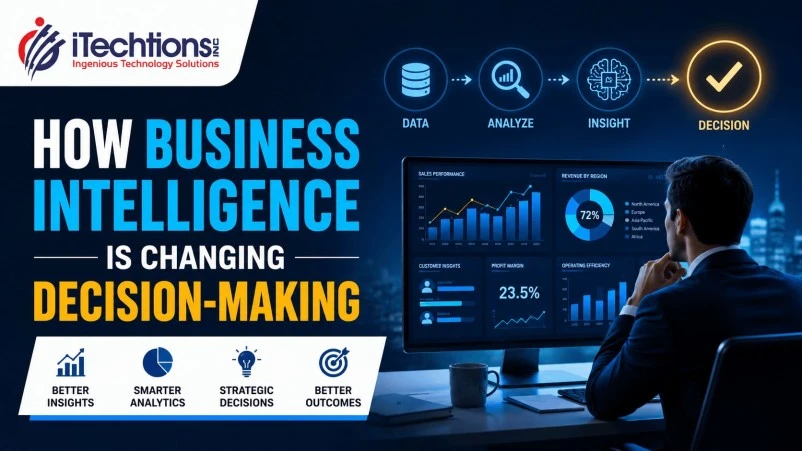
The evolution of BI can be summarized as a shift from reporting to intelligence.
|
Traditional BI |
Modern BI in 2026 |
|
Historical reporting |
Real-time intelligence |
|
Static dashboards |
Interactive analytics |
|
Manual analysis |
AI-assisted analysis |
|
Technical queries |
Natural-language questions |
|
Human-led investigation |
AI-assisted investigation |
|
Descriptive analytics |
Predictive and prescriptive analytics |
|
Separate BI tools |
Embedded analytics |
|
Data access |
Governed data access |
|
Multiple metric definitions |
Semantic consistency |
This transformation allows businesses to move faster while making decisions based on more comprehensive information.
How Businesses Can Prepare for the Future of BI
Adopting every new BI technology at once is not necessarily the right approach.
Organizations should begin with business problems rather than technology.
1. Define the decisions that matter
Identify the decisions where better data could have the biggest business impact.
2. Audit your existing data
Determine whether your data is accurate, complete, accessible, and consistent.
3. Establish governance
Define who can access data, how data should be used, and how AI-generated insights should be reviewed.
4. Standardize important metrics
Create consistent definitions for KPIs such as revenue, profit, customer acquisition cost, retention, and churn.
5. Introduce AI strategically
Start with practical use cases such as natural-language analytics, anomaly detection, forecasting, and automated reporting.
6. Enable self-service analytics
Give business teams access to relevant information while maintaining appropriate governance.
7. Measure business outcomes
The success of a BI initiative should not be measured only by the number of dashboards created.
Instead, measure outcomes such as:
-
Faster decision-making
-
Reduced operational costs
-
Increased revenue
-
Improved forecasting
-
Better customer retention
- Reduced reporting effort
The Future of Business Intelligence: From Insights to Action
The most important shift in BI in 2026 is that organizations are moving beyond simply understanding data.
The goal is to use data to make better decisions faster.
AI-powered analytics, agentic BI, real-time intelligence, semantic layers, predictive analytics, embedded analytics, and stronger governance are bringing businesses closer to this goal.
However, technology should remain a means rather than the objective.
The organizations that gain the most value from BI will be those that combine high-quality data, strong governance, intelligent technology, and human judgment.
Business Intelligence is no longer just about building better dashboards.
It is about creating an organization where every important decision can be supported by trustworthy, timely, and actionable intelligence.
Frequently Asked Questions About Business Intelligence Trends 2026
What are the biggest Business Intelligence trends in 2026?
The major trends include AI-powered BI, agentic analytics, conversational BI, real-time analytics, semantic layers, predictive analytics, embedded analytics, modern data architectures, stronger data governance, and greater data and AI literacy.
How is AI changing Business Intelligence?
AI is automating data preparation, natural-language querying, anomaly detection, forecasting, insight generation, and other analytical tasks. It is also enabling more proactive and autonomous forms of analytics.
What is agentic BI?
Agentic BI uses AI agents to monitor data, investigate patterns, identify potential issues, generate insights, and potentially recommend or initiate actions with appropriate human oversight and governance.
Why is a semantic layer important for BI?
A semantic layer provides consistent definitions for business metrics and data relationships. It helps ensure that dashboards, analysts, and AI systems use the same business logic.
Is real-time BI important for businesses?
Yes. Real-time BI can help organizations respond quickly to changing conditions in areas such as fraud detection, inventory, pricing, customer behavior, and operational monitoring.
How can businesses get started with modern BI?
Businesses should start by identifying important decisions and use cases, assessing data quality, establishing governance, standardizing KPIs, and then selecting BI and AI capabilities that address specific business needs.
Conclusion
Business Intelligence trends in 2026 demonstrate a clear movement toward AI-assisted, real-time, governed, and action-oriented analytics.
The future is not simply about collecting more data or creating more dashboards. It is about connecting reliable data with intelligent technology so businesses can understand what is happening, anticipate what comes next, and act with confidence.
For organizations planning their next phase of digital transformation, now is the time to rethink BI as a strategic capability—not just a reporting tool.
The businesses that turn data into decisions faster will be better positioned to compete in an increasingly intelligent and data-driven economy.