
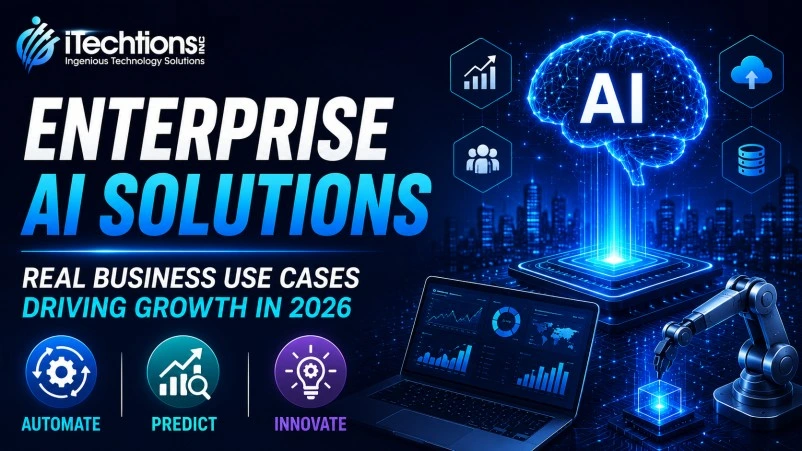
Artificial Intelligence (AI) and Machine Learning (ML) have evolved from emerging technologies into essential business tools. In 2026, organizations across industries are leveraging Enterprise AI Solutions to streamline operations, improve customer experiences, and make smarter decisions. What was once considered a competitive advantage has now become a necessity for businesses aiming to stay ahead in a rapidly changing market.
From predictive analytics to intelligent automation, AI is transforming how enterprises operate. This article explores the most impactful real-world business use cases and highlights how companies are achieving measurable results through AI-driven innovation.
Why Enterprises Are Investing in AI and Machine Learning
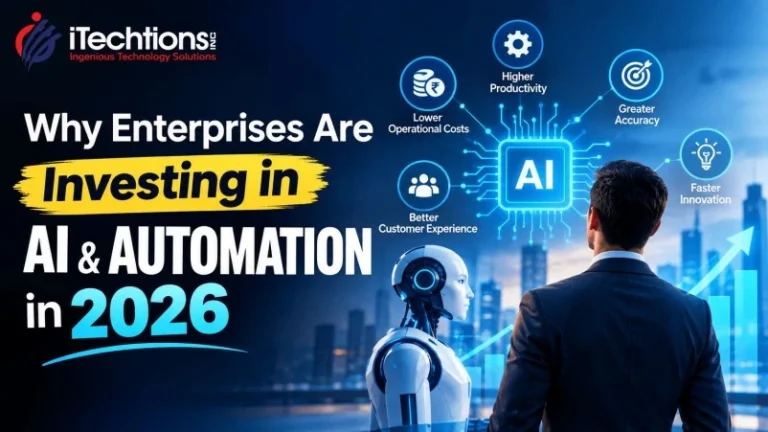
The growing volume of business data and the need for faster decision-making have accelerated the adoption of AI technologies. Modern Enterprise AI Solutions help organizations process vast amounts of information, identify patterns, and automate repetitive tasks with greater accuracy than traditional methods.
Businesses are increasingly embracing machine learning in business to enhance efficiency, reduce operational costs, and gain deeper insights into customer behavior. These technologies enable organizations to move from reactive decision-making to proactive business strategies.
Key Enterprise AI Applications Transforming Businesses
1. Intelligent Customer Support
Customer service has become one of the most common Enterprise AI Applications. AI-powered chatbots and virtual assistants can handle routine customer inquiries, resolve issues quickly, and provide 24/7 support.
By implementing AI powered automation, businesses can significantly reduce response times while allowing human agents to focus on more complex customer concerns. This leads to improved customer satisfaction and lower support costs.
2. Predictive Analytics for Better Decision-Making
One of the most valuable uses of machine learning in business is predictive analytics. AI systems analyze historical data to forecast future trends, customer demand, and potential risks.
Retailers use predictive models to optimize inventory levels, while financial institutions leverage AI to identify investment opportunities and detect fraudulent activities. These insights help organizations make informed decisions based on data rather than assumptions.
3. Business Process Automation
Many enterprises are adopting business process automation to eliminate repetitive manual tasks. Activities such as invoice processing, data entry, document verification, and approval workflows can now be automated with AI-driven systems.
Advanced business process automation tools improve operational efficiency, reduce human error, and accelerate business workflows. As a result, employees can dedicate more time to strategic and value-generating activities.
4. Personalized Marketing and Sales
Modern consumers expect personalized experiences. AI enables businesses to analyze customer preferences, purchase history, and browsing behavior to deliver targeted marketing campaigns.
Using Enterprise AI Applications, companies can recommend relevant products, optimize advertising efforts, and increase conversion rates. This level of personalization helps businesses build stronger customer relationships and drive revenue growth.
5. Fraud Detection and Cybersecurity
Cybersecurity threats continue to evolve, making traditional security methods less effective. AI-powered security systems monitor network activity in real time and identify unusual behavior before it becomes a major threat.
Many organizations rely on Enterprise AI Solutions to strengthen cybersecurity, detect fraud, and protect sensitive business information. Machine learning algorithms continuously learn from new threats, improving detection accuracy over time.
AI in Human Resources and Workforce Management
Human resource departments are increasingly integrating AI into recruitment and workforce planning. AI can screen resumes, identify qualified candidates, and even predict employee retention risks.
By incorporating AI powered automation into HR processes, organizations can reduce hiring time and improve talent acquisition outcomes. AI also helps managers make data-driven decisions regarding employee development and performance management.
Benefits of AI Adoption in Enterprises
The benefits of AI in business extend beyond operational efficiency. AI creates opportunities for innovation, scalability, and long-term growth.
Some of the major benefits include:
-
Faster and more accurate decision-making
-
Reduced operational costs
-
Improved customer experiences
-
Enhanced productivity and efficiency
-
Better risk management
-
Increased revenue opportunities
-
Smarter resource allocation
The advantages of AI in business become even more significant when organizations integrate AI into multiple departments, creating a connected and intelligent enterprise ecosystem.
Challenges Enterprises Must Address
While AI offers tremendous opportunities, successful implementation requires careful planning. Businesses must address challenges such as data quality, privacy concerns, integration complexity, and employee training.
Organizations that invest in proper AI governance frameworks and skilled talent are more likely to achieve sustainable results from their Enterprise AI Solutions investments.
The Future of Enterprise AI in 2026 and Beyond
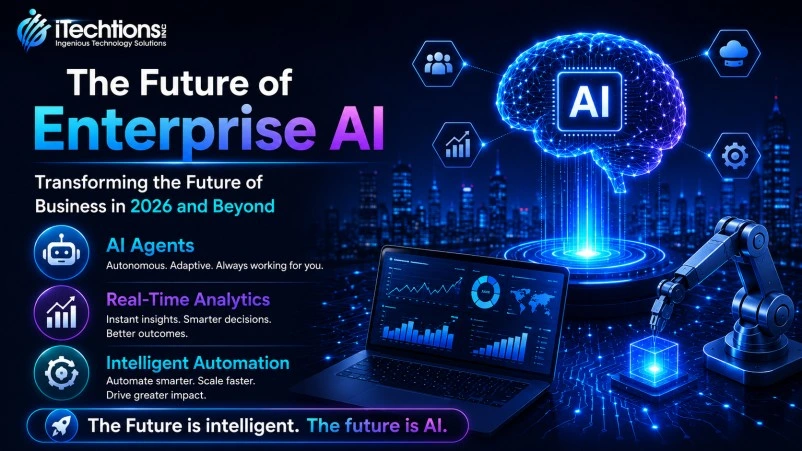
As AI technology continues to evolve, enterprises are moving toward more advanced capabilities such as generative AI, autonomous AI agents, and intelligent decision-support systems.
Future Enterprise AI Applications will focus on deeper automation, real-time analytics, and seamless collaboration between humans and AI systems. Companies that embrace innovation today will be better positioned to adapt to future market demands.
Frequently Asked Questions
Q1. What are Enterprise AI Solutions?
Enterprise AI Solutions are AI-driven technologies that help businesses automate processes, analyze data, and improve operational efficiency.
Q2. How is machine learning used in business?
Machine learning in business is used for predictive analytics, customer insights, fraud detection, forecasting, and process optimization.
Q3. What are the benefits of AI in business?
AI improves productivity, reduces costs, enhances customer experiences, and supports better decision-making.
Q4. Which industries benefit most from Enterprise AI Applications?
Healthcare, finance, retail, manufacturing, logistics, and technology sectors are among the biggest adopters of AI.
Q5. Can AI replace human employees?
AI is designed to augment human capabilities by automating repetitive tasks, allowing employees to focus on higher-value work.
Conclusion
AI and Machine Learning are no longer future concepts—they are actively reshaping enterprises in 2026. From customer support and predictive analytics to cybersecurity and business process automation, organizations are discovering new ways to improve efficiency and drive growth.
By adopting the right Enterprise AI Solutions, businesses can unlock valuable insights, streamline operations, and create competitive advantages in an increasingly digital marketplace. With support from innovative technology companies such as Itechtions, organizations can accelerate their AI journey and stay ahead of evolving market demands. The organizations that successfully integrate AI today will be the ones leading innovation tomorrow.