


The business world is evolving rapidly, and organizations are under constant pressure to innovate, improve efficiency, and adapt to changing customer demands. In 2026, cloud technology continues to play a critical role in helping enterprises achieve these goals. However, simply moving data and applications to the cloud is no longer enough. Companies need a well-defined approach to maximize the value of their cloud investments and accelerate growth.
At Itechtions, we help businesses unlock the full potential of cloud technologies through strategic planning, seamless implementation, and continuous optimization.
A successful cloud strategy enables businesses to streamline operations, improve scalability, reduce costs, and foster innovation.
What Is a Cloud Enablement Strategy?
A Cloud Enablement Strategy is a structured approach that helps organizations adopt, manage, and optimize cloud technologies to achieve specific business objectives. It involves assessing existing infrastructure, planning cloud adoption, implementing cloud solutions, and continuously optimizing cloud environments.
Unlike traditional cloud migration projects, cloud enablement focuses on creating a long-term framework that supports innovation, flexibility, and business scalability.
Businesses that invest in effective cloud enablement services gain a competitive advantage by improving operational efficiency and enabling faster decision-making.
Why Cloud Enablement Matters in 2026
The demand for digital services, remote collaboration, and data-driven decision-making continues to grow. Organizations need technology platforms that can scale quickly without increasing operational complexity.
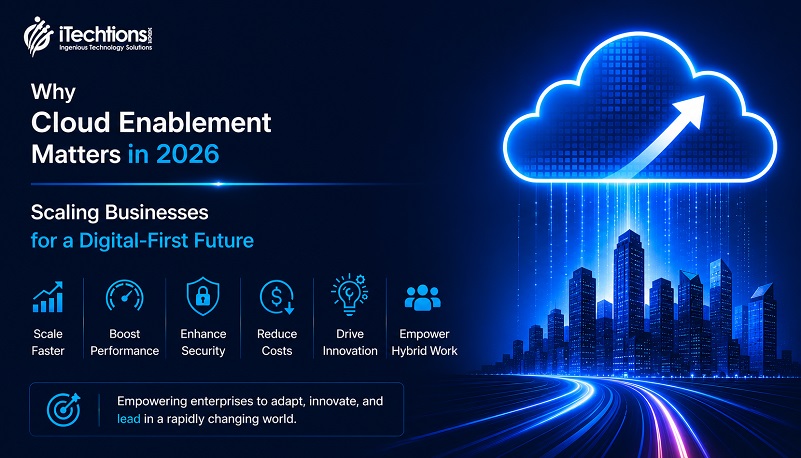
A strong cloud strategy helps enterprises:
-
Scale resources based on business needs.
-
Improve application performance and reliability.
-
Reduce infrastructure and maintenance costs.
-
Enhance security and compliance.
-
Accelerate product development cycles.
-
Support hybrid and remote work environments.
As a result, enterprise cloud transformation has become a strategic priority for organizations across industries.
How to Create a Cloud Enablement Strategy
Many organizations ask, How to create a cloud enablement strategy that delivers measurable business outcomes. While every business has unique requirements, the process typically follows several key steps.
1. Assess Current Infrastructure
The first step is understanding the organization’s existing technology environment. Businesses should evaluate applications, databases, servers, and workflows to identify opportunities for cloud adoption and modernization.
2. Define Business Goals
Cloud initiatives should align with business objectives. Whether the goal is improving customer experience, reducing costs, or increasing operational agility, clear objectives provide direction for the strategy.
3. Select the Right Cloud Model
Organizations can choose from public, private, hybrid, or multi-cloud environments depending on their requirements for security, performance, and compliance.
4. Plan Cloud Migration
A detailed migration roadmap ensures a smooth transition. Professional cloud migration services help businesses move workloads, applications, and data to the cloud while minimizing disruptions.
5. Establish Governance and Security
Strong governance policies ensure cloud resources are used efficiently and securely. This includes access controls, compliance monitoring, and data protection measures.
6. Continuously Optimize Performance
Cloud adoption is an ongoing process. Organizations should regularly monitor performance, costs, and security to maximize value from their cloud investments.
Key Technologies Driving Enterprise Cloud Growth
Several emerging technologies are helping enterprises scale faster through cloud enablement.
Cloud Native Applications
Modern organizations increasingly rely on cloud native applications that are specifically designed for cloud environments. These applications offer greater flexibility, faster deployment, improved resilience, and easier scalability compared to traditional software.
Cloud-native development enables businesses to innovate quickly and respond to changing market demands without major infrastructure changes.
AI-Powered Cloud Operations
Artificial intelligence is transforming cloud management by automating routine tasks, predicting system failures, and optimizing resource utilization. AI-driven cloud operations improve efficiency while reducing operational costs.
Multi-Cloud and Hybrid Cloud Environments
Many enterprises now use multiple cloud providers to improve flexibility and avoid vendor lock-in. Hybrid cloud environments also allow organizations to balance security requirements with scalability needs.
The Role of Cloud Infrastructure Management
Effective cloud infrastructure management is essential for maintaining performance, security, and cost efficiency.
Organizations must manage:
-
Cloud resources and workloads.
-
Network performance.
-
Data storage and backups.
-
Security monitoring.
-
Compliance requirements.
-
Cost optimization initiatives.
By implementing strong management practices, businesses can ensure their cloud environments remain reliable, secure, and aligned with business goals.
Benefits of Cloud Enablement Services
Professional cloud enablement services help organizations accelerate their cloud journey while reducing risks and implementation challenges.
Some of the major benefits include:
-
Faster cloud adoption.
-
Reduced operational expenses.
-
Improved business agility.
-
Enhanced cybersecurity.
-
Better disaster recovery capabilities.
-
Increased scalability and flexibility.
-
Faster innovation and product delivery.
Organizations that leverage expert cloud services are better positioned to compete in today’s fast-changing digital economy.
Common Challenges Enterprises Face
Although cloud adoption offers significant advantages, organizations may encounter challenges such as:
-
Legacy system integration.
-
Data migration complexity.
-
Security and compliance concerns.
-
Managing multi-cloud environments.
-
Skill gaps within internal teams.
-
Controlling cloud spending.
Addressing these challenges requires careful planning, strong governance, and ongoing optimization efforts.
Frequently Asked Questions (FAQs)
Q1. What is a Cloud Enablement Strategy?
A Cloud Enablement Strategy is a structured plan for adopting, managing, and optimizing cloud technologies to achieve business goals.
Q2. Why is cloud enablement important for enterprises?
It helps organizations improve scalability, reduce costs, increase agility, and accelerate digital transformation.
Q3. What are cloud migration services?
Cloud migration services assist businesses in moving applications, data, and workloads from on-premises systems to cloud environments.
Q4. What are cloud native applications?
Cloud native applications are software solutions specifically built to run efficiently in cloud environments.
Q5. How does cloud infrastructure management support business growth?
It ensures cloud resources remain secure, optimized, scalable, and cost-effective.
Conclusion
In 2026, a well-planned cloud adoption framework is more than a technology initiative—it is a business growth strategy. As organizations continue their journey toward enterprise cloud transformation, cloud technologies provide the scalability, flexibility, and innovation needed to stay competitive.
By investing in cloud enablement services, leveraging cloud migration services, adopting cloud native applications, and strengthening cloud infrastructure management, enterprises can build a future-ready digital foundation.
At Itechtions, we are committed to helping organizations navigate their cloud journey with confidence, enabling them to achieve sustainable growth, operational excellence, and long-term success in an increasingly digital world.